Literature Review of Roberts Seven-stage Crisis Intervention Model
Cursory Handling and Crisis Intervention Advance Admission originally published online on October 12, 2005
Cursory Treatment and Crunch Intervention 2005 5(four):329-339; doi:x.1093/brief-treatment/mhi030
© The Author 2005. Published past Oxford University Printing. All rights reserved. For permissions, please due east-postal service: journals.permissions@oxfordjournals.org.
Original Article
The Seven-Stage Crisis Intervention Model: A Route Map to Goal Attainment, Problem Solving, and Crisis Resolution
From Rutgers, The Country University of New Bailiwick of jersey (Roberts) and Northern Illinois University (Ottens)
Contact author: Albert R. Roberts, Professor, Criminal Justice, Kinesthesia of Arts and Sciences, Rutgers, The State University of New Bailiwick of jersey, Lucy Stone Hall, B wing, 261 Piscataway, NJ 08854. Electronic mail: prof.albertroberts{at}comcast.net.
This commodity explicates a systematic and structured conceptual model for crisis cess and intervention that facilitates planning for constructive brief treatment in outpatient psychiatric clinics, customs mental wellness centers, counseling centers, or crisis intervention settings. Awarding of Roberts' seven-stage crisis intervention model can facilitate the clinician'south constructive intervening by emphasizing rapid assessment of the client's problem and resources, collaborating on goal selection and attainment, finding alternative coping methods, developing a working alliance, and building upon the client's strengths. Limitations on treatment fourth dimension past insurance companies and managed intendance organizations take made evidence-based crunch intervention a critical necessity for millions of persons presenting to mental health clinics and hospital-based programs in the midst of acute crunch episodes. Having a crisis intervention protocol facilitates treatment planning and intervention. The authors clarify the singled-out differences betwixt disaster management and crisis intervention and when each is critically needed. Also, noted is the importance of congenital-in evaluations, outcome measures, and performance indicators for all crunch intervention services and programs. Nosotros are recommending that the Roberts' crisis intervention tool be used for time-limited response to persons in astute crisis.
KEY WORDS: crunch intervention, lethality assessment, establish rapport, coping, performance indicators, precipitating event, disaster management
We live in an era in which crisis-inducing events and acute crunch episodes are prevalent. Each twelvemonth, millions of people are confronted with crunch-inducing events that they cannot resolve on their ain, and they often plough for help to crisis units of community mental health centers, psychiatric screening units, outpatient clinics, infirmary emergency rooms, higher counseling centers, family unit counseling agencies, and domestic violence programs (Roberts, 2005).
Imagine the following scenarios:
- You are a community social worker or psychologist working with the Houston Law Department to evangelize crunch intervention services to police, emergency responders, and survivors of Hurricane Katrina who but arrived at the Houston Astrodome disaster shelter. It is midnight and one of the survivors (who was brutally raped one week prior to Hurricane Katrina) wakes upwards screaming and throwing things at the boyfriend in the cot next to hers. You were walking out the door to drive abode and get a few hours sleep, but instead you are called on the loudspeaker to defuse the astute crunch episode and provide crisis intervention services.
- Y'all are a crunch consultant to a large Fortune 500 corporation, and a volatile domestic violence-related shooting took place last calendar week at the corporate headquarters. The employee assistance counselor, the director of grooming, the director of strategic planning, and the manager of disaster planning want you to provide crisis intervention training to all employee assistance counselors and all corporate security officers.
- You are the new psychiatrist in an inpatient psychiatric unit with 50 patients diagnosed with co-occurring disorders; over the weekend a patient assaulted the psychiatric resident you are supervising. The resident wants to be transferred to another unit of measurement of the hospital because he had a nightmare and cold sweats last night. What do you lot do now? What types of training should be provided to all psychiatric residents and mental wellness clinicians in lodge to forbid patient–staff conflict from reaching a crisis point?
- You are the counseling psychologist at a land academy assigned to see walk-in emergency clients. An 18-year-old freshman appears one afternoon and tells you she merely came from her residence hall room and found her fellow in bed with her "all-time friend" roommate. Now she tells you she is seriously considering taking an overdose of nonaspirin pain capsules in their presence to "teach them a lesson." How tin crisis intervention help her to find adaptive coping skills and a more effective trouble-solving approach to her predicament?
This article delineates and discusses a systematic and structured conceptual model for crisis intervention useful with persons calling or walking into an outpatient psychiatric clinic, psychiatric screening center, counseling centre, or crisis intervention plan. A model is a prototype of the real-life clinical process the crunch clinician/counselor would like to implement. A systematic crisis intervention model is analogous to establishing a route map as a model of the actual roads, highways, and directions one will be taking on a trip. Thus, the clinician can visualize the implications of each proposed crunch intervention guidepost and technique in the model's process and sequence of events and make any necessary adjustments before the program is fully operational. The model is a serial of guideposts that makes it easier to remember culling methods and techniques, thus facilitating the counseling process. By learning about each component or stage of a model, the clinician volition improve understand how each component relates to ane another and should facilitate goal attainment, problem solving, and crisis resolution.
The focus of this article is on the clinical application of Roberts' seven-stage crisis intervention model (R-SSCIM) to those clients who present in a crisis state equally a consequence of an interpersonal conflict (due east.grand., broken romance or divorce), a crisis-inducing event (due east.g., dating violence and sexual assault), or a preexisting mental health problem that flares-upwardly. Crisis states can be precipitated by natural disasters, such as Hurricane Katrina, which took identify equally this article went to press. However, at that place is a functional difference between crisis intervention and disaster management. A large-scale community disaster such as a major hurricane first requires disaster management, then emergency rescue services. The commencement two phases address the event itself, rather than the psychological needs and responses of those who experienced the disaster. For some, the issue will overwhelm their ability to cope; it is those people for whom R-SSCIM is invaluable. We will talk over the differences betwixt disaster management and crunch intervention later in this article.
Crunch clinicians must respond quickly to the challenges posed by clients presenting in a crisis state. Disquisitional decisions demand to exist made on behalf of the customer. Clinicians need to be aware that some clients in crisis are making one last heroic effort to seek assistance and hence may exist highly motivated to attempt something unlike. Thus, a time of crunch seems to be an opportunity to maximize the crunch clinician's ability to intervene effectively as long as he or she is focused in the here and at present, willing to rapidly assess the client'due south problem and resource, suggest goals and alternative coping methods, develop a working alliance, and build upon the client's strengths. At the showtime it is critically important to found rapport while assessing lethality and determining the precipitating events/situations. It is then of import to identify the master presenting problem and mutually concord on brusque-term goals and tasks. By its nature, crunch intervention involves identifying failed coping skills and then helping the client to replace them with adaptive coping skills.
Information technology is imperative that all mental health clinicians—counseling psychologists, mental health counselors, clinical psychologists, psychiatrists, psychiatric nurses, social workers, and crisis hotline workers—be well versed and knowledgeable in the principles and practices of crisis intervention. Several 1000000 individuals encounter crisis-inducing events annually, and crisis intervention seems to exist the emerging therapeutic method of option for most individuals.
 | Crisis Intervention: The Demand for a Model |
|---|
 Peak Peak Crisis Intervention: The Need... Crisis Intervention: The Need...  Roberts' Seven-Phase Crisis...Differentiating Crisis...Evaluation Research and Outcome...ConclusionReferences Roberts' Seven-Phase Crisis...Differentiating Crisis...Evaluation Research and Outcome...ConclusionReferences |
|---|
A "crisis" has been defined as
An astute disruption of psychological homeostasis in which one's usual coping mechanisms fail and there exists evidence of distress and functional impairment. The subjective reaction to a stressful life experience that compromises the individual'due south stability and ability to cope or role. The main cause of a crisis is an intensely stressful, traumatic, or chancy issue, but two other weather are besides necessary: (one) the individual's perception of the event as the crusade of considerable upset and/or disruption; and (2) the private's inability to resolve the disruption by previously used coping mechanisms. Crisis also refers to "an upset in the steady state." It frequently has v components: a hazardous or traumatic result, a vulnerable or unbalanced land, a precipitating gene, an active crisis state based on the person's perception, and the resolution of the crunch. (Roberts, 2005, p. 778)
Given such a definition, it is imperative that crunch workers have in mind a framework or blueprint to guide them in responding. In brusque, a crisis intervention model is needed, and i is needed for a host of reasons, such every bit the ones given as follows.
When confronted by a person in crisis, clinicians need to address that person's distress, impairment, and instability by operating in a logical and orderly process (Greenstone & Leviton, 2002). The crunch worker, ofttimes with limited clinical experience, is less probable to exacerbate the crisis with well-intentioned but haphazard responding when trained to work inside the framework of a systematic crunch intervention model. A comprehensive model allows the novice as well as the experienced clinician to exist mindful of maintaining the fine line that allows for a response that is active and directive enough simply does not take problem ownership away from the customer. Finally, a model should suggest steps for how the crunch worker can intentionally encounter the client where he or she is at, assess level of risk, mobilize client resources, and move strategically to stabilize the crunch and ameliorate performance.
Crisis intervention is no longer regarded equally a passing fad or as an emerging subject field. It has now evolved into a specialty mental health field that stands on its own. Based on a solid theoretical foundation and a praxis that is born out of over fifty years of empirical and experiential grounding, crisis intervention has become a multidimensional and flexible intervention method. The roots of crisis intervention come up from the pioneering piece of work of 2 community psychiatrists—Erich Lindemann and Gerald Caplan in the mid-1940s, 1950s, and 1960s. We accept come a far weep from its inception in the 1950s and 1960s. Specifically, in 1943 and 1944 customs psychiatrist, Dr. Erich Lindemann at Massachusetts General Hospital conceptualized crisis theory based on his work with many acute and grief stricken survivors and relatives of the 493 dead victims of Boston's worst nightclub fire at the Coconut Grove. Gerald Caplan, a psychiatry professor at Massachusetts General Hospital and the Harvard School of Public Health, expanded Lindemann's (1944) pioneering work. Caplan (1961, 1964) was the first clinician to describe and document the four stages of a crisis reaction: initial ascent of tension from the emotionally hazardous crunch precipitating event, increased disruption of daily living because the individual is stuck and cannot resolve the crisis quickly, tension speedily increases as the individual fails to resolve the crisis through emergency problem-solving methods, and the person goes into a depression or mental collapse or may partially resolve the crunch by using new coping methods.
A number of crisis intervention exercise models accept been promulgated over the years (e.yard., Collins & Collins, 2005; Greenstone & Leviton, 2002; Jones, 1968; Roberts & Grau, 1970). Withal, there is one crunch intervention model that builds upon and expands the seminal thinking of the founders of crisis theory, Caplan (1964), Golan (1978), and Lindemann (1944): the R-SSCIM (Roberts, 1991, 1995, 1998, 2005). It represents a applied example of a stepwise design for crisis responding that has applicability beyond a wide spectrum of crunch situations. What follows is an explication of that model.
| | Roberts' Vii-Stage Crisis Intervention Model |
|---|
| TOPCrisis Intervention: The Need... Roberts' Seven-Stage Crisis... Differentiating Crisis...Evaluation Research and Issue...ConclusionReferences |
|---|
In conceptualizing the process of crunch intervention, Roberts (1991, 2000, 2005) has identified vii disquisitional stages through which clients typically pass on the route to crunch stabilization, resolution, and mastery (Figure i). These stages, listed below, are essential, sequential, and sometimes overlapping in the process of crisis intervention:
- plan and conduct a thorough biopsychosocial and lethality/imminent danger assessment;
- make psychological contact and quickly establish the collaborative human relationship;
- identify the major problems, including crisis precipitants;
- encourage an exploration of feelings and emotions;
- generate and explore alternatives and new coping strategies;
- restore functioning through implementation of an action programme;
- plan follow-up and booster sessions.
What follows is an explication of that model.
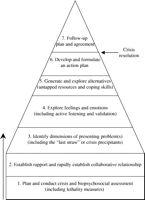 View larger version (23K): [in a new window] | Effigy 1 Roberts' Seven Stage Crisis Intervention Model Source: Copyright © Albert R. Roberts, 1991. Reprinted by permission of the author. |
Phase I: Psychosocial and Lethality Cess
The crisis worker must carry a swift just thorough biopsychosocial assessment. At a minimum, this assessment should embrace the client's environmental supports and stressors, medical needs and medications, current use of drugs and alcohol, and internal and external coping methods and resources (Eaton & Ertl, 2000). I useful (and rapid) method for assessing the emotional, cognitive, and behavioral aspects of a crisis reaction is the triage assessment model (Myer, 2001; Myer, Williams, Ottens, & Schmidt, 1992, Roberts, 2002).
Assessing lethality, first and foremost, involves ascertaining whether the customer has actually initiated a suicide attempt, such as ingesting a poison or overdose of medication. If no suicide attempt is in progress, the crisis worker should enquire about the customer's "potential" for self-harm. This assessment requires
- asking well-nigh suicidal thoughts and feelings (due east.g., "When you say you can't take it anymore, is that an indication you are thinking of hurting yourself?");
- estimating the force of the client's psychological intent to inflict deadly damage (e.chiliad., a hotline caller who suffers from a fatal disease or painful condition may have strong intent);
- gauging the lethality of suicide plan (e.g., does the person in crunch have a plan? how viable is the plan? does the person in crisis have a method in mind to carry out the plan? how lethal is the method? does the person have admission to a ways of self-harm, such as drugs or a firearm?);
- inquiring about suicide history;
- taking into consideration sure adventure factors (eastward.g., is the client socially isolated or depressed, experiencing a meaning loss such as divorce or layoff?).
With regard to imminent danger, the crisis worker must establish, for example, if the caller on the hotline is now a target of domestic violence, a vehement stalker, or sexual abuse.
Rather than grilling the customer for assessment data, the sensitive clinician or counselor uses an artful interviewing fashion that allows this information to emerge as the client'due south story unfolds. A good cess is likely to accept occurred if the clinician has a solid understanding of the client's state of affairs, and the client, in this process, feels as though he or she has been heard and understood. Thus, it is quite understandable that in the Roberts model, Stage I—Assessment and Stage Two—Rapidly Plant Rapport are very much intertwined.
Stage Two: Rapidly Establish Rapport
Rapport is facilitated past the presence of counselor-offered conditions such as genuineness, respect, and acceptance of the customer (Roberts, 2005). This is likewise the stage in which the traits, behaviors, or fundamental graphic symbol strengths of the crunch worker come to fore in gild to instill trust and confidence in the client. Although a host of such strengths have been identified, some of the about prominent include good heart contact, nonjudgmental attitude, creativity, flexibility, positive attitude, reinforcing minor gains, and resiliency.
Stage Three: Place the Major Problems or Crisis Precipitants
Crisis intervention focuses on the client's electric current problems, which are often the ones that precipitated the crisis. Equally Ewing (1978) pointed out, the crunch worker is interested in elucidating just what in the customer's life has led her or him to require help at the present fourth dimension. Thus, the question asked from a variety of angles is "Why at present?"
Roberts (2005) suggested not only inquiring nigh the precipitating event (the proverbial "terminal straw") only also prioritizing issues in terms of which to work on first, a concept referred to equally "looking for leverage" (Egan, 2002). In the course of understanding how the upshot escalated into a crunch, the clinician gains an evolving conceptualization of the client's "modal coping style"—one that will likely require modification if the nowadays crunch is to be resolved and hereafter crises prevented. For example, Ottens and Pinson (2005) in their piece of work with caregivers in crisis have identified a repetitive coping mode—argue with care recipient-acquiesce to intendance recipient'south demands-blame cocky when giving in fails—that tin eventually escalate into a crisis.
Stage 4: Deal With Feelings and Emotions
There are two aspects to Stage Four. The crisis worker strives to allow the client to limited feelings, to vent and heal, and to explain her or his story near the current crisis situation. To do this, the crunch worker relies on the familiar "active listening" skills similar paraphrasing, reflecting feelings, and probing (Egan, 2002). Very cautiously, the crunch worker must somewhen work challenging responses into the crisis-counseling dialogue. Challenging responses tin can include giving information, reframing, interpretations, and playing "devil'south advocate." Challenging responses, if accordingly applied, assistance to loosen clients' maladaptive beliefs and to consider other behavioral options. For case, in our earlier example of the young woman who found beau and roommate locked in a cheating embrace, the counselor at Phase Iv allows the woman to express her feelings of hurt and jealousy and to tell her story of trust betrayed. The counselor, at a judicious moment, volition wonder out loud whether taking an overdose of acetaminophen will be the most constructive manner of getting her bespeak beyond.
Stage V: Generate and Explore Alternatives
This stage can often be the nearly hard to accomplish in crisis intervention. Clients in crunch, by definition, lack the equanimity to study the large picture and tend to adamantly cling to familiar ways of coping fifty-fifty when they are backfiring. Withal, if Stage Iv has been accomplished, the customer in crisis has probably worked through enough feelings to re-establish some emotional balance. Now, clinician and client can brainstorm to put options on the table, like a no-suicide contract or brief hospitalization, for ensuring the customer's safety; or hash out alternatives for finding temporary housing; or consider the pros and cons of diverse programs for treating chemical dependency. It is important to keep in mind that these alternatives are better when they are generated collaboratively and when the alternatives selected are "owned" by the customer.
The clinician certainly tin ask most what the client has institute that works in similar situations. For example, it frequently happens that relatively recent immigrants or bicultural clients will experience crises that occur as a outcome of a cultural clash or "mismatch," as when values or customs of the traditional culture are ignored or violated in the United states of america. For example, in Mexico the custom is to accompany or be an escort when one'south daughter starts dating. The United states has no such custom. It may aid to consider how the client has coped with or negotiated other cultural mismatches. If this crisis precipitant is a unique experience, then clinician and customer can begin alternatives—sometimes the more outlandish, the better—that tin be applied to the current upshot. Solution-focused therapy techniques, such equally "Amplifying Solution Talk" (DeJong & Berg, 1998) can be integrated into Stage IV.
Phase Vi: Implement an Activeness Programme
Here is where strategies become integrated into an empowering treatment programme or co-ordinated intervention. Jobes, Berman, and Martin (2005), who described crunch intervention with high-risk, suicidal youth, noted the shift that occurs at Phase Six from crunch to resolution. For these suicidal youth, an action program tin involve several elements:
- removing the means—involving parents or significant others in the removal of all lethal means and safeguarding the surround;
- negotiating safety—time-limited agreements during which the client will agree to maintain his or her safe;
- hereafter linkage—scheduling telephone calls, subsequent clinical contacts, events to wait forward to;
- decreasing anxiety and sleep loss—if acutely anxious, medication may be indicated but carefully monitored;
- decreasing isolation—friends, family, neighbors need to be mobilized to keep ongoing contact with the youth in crisis;
- hospitalization—a necessary intervention if adventure remains unabated and the patient is unable to contract for his or her own condom (run into Jobes et al., 2005, p. 411).
Obviously, the concrete action plans taken at this phase (e.g., inbound a 12-step treatment program, joining a back up group, seeking temporary residence in a women's shelter) are disquisitional for restoring the client's equilibrium and psychological balance. However, there is some other dimension that is essential to Stage Six, as Roberts (2005) indicated, and that is the cognitive dimension. Thus, recovering from a divorce or death of a child or drug overdose requires making some meaning out of the crisis event: why did it happen? What does it mean? What are culling constructions that could accept been placed on the result? Who was involved? How did actual events conflict with one's expectations? What responses (cognitive or behavioral) to the crisis actually made things worse? Working through the meaning of the event is important for gaining mastery over the situation and for being able to cope with like situations in the future.
Stage VII: Follow-Up
Crisis workers should plan for a follow-upward contact with the client subsequently the initial intervention to ensure that the crisis is on its style to being resolved and to evaluate the postcrisis status of the customer. This postcrisis evaluation of the client can include
- physical condition of the customer (e.one thousand., sleeping, nutrition, hygiene);
- cerebral mastery of the precipitating event (does the customer have a better agreement of what happened and why it happened?);
- an assessment of overall functioning including, social, spiritual, employment, and academic;
- satisfaction and progress with ongoing treatment (east.chiliad., financial counseling);
- whatever current stressors and how those are being handled;
- need for possible referrals (e.g., legal, housing, medical).
Follow-upwardly can also include the scheduling of a "booster" session in most a month later on the crisis intervention has been terminated. Treatment gains and potential problems can be discussed at the booster session. For those counselors working with grieving clients, it is recommended that a follow-up session exist scheduled effectually the anniversary date of the deceased's death (Worden, 2002). Similarly, for those crisis counselors working with victims of violent crimes, it is recommended that a follow-up session exist scheduled at the ane-month and 1-year anniversary of the victimization.
| | Differentiating Crisis Intervention From Disaster Direction |
|---|
| TOPCrisis Intervention: The Need...Roberts' Vii-Stage Crunch... Differentiating Crunch... Evaluation Research and Consequence...ConclusionReferences |
|---|
For those in need, the third phase of disaster response—crunch intervention—ordinarily begins 1–four weeks after the disaster unfolds. Phase I is generally known every bit "Impact" and Stage II is known as the "Heroic or Rescue" stage. Phases I and II involve the disaster management and emergency relief efforts of local and state police, firefighters and rescue squads, emergency medical technicians, the American Red Cross volunteers, the Salvation Army, and the Federal Emergency Direction Bureau. The disaster and emergency direction agencies focus on public safe; on locating disaster shelters, temporary housing units, and host homes; and on providing nutrient, make clean water, clothing, transportation, and medical intendance for survivors and their families. After the survivors and their families are rescued and transported to dry country and safe shelter, the goal is to provide them with well-balanced meals, continued medical care, sleep, and residue. It is as well critically important to help survivors to reconnect and reunite with family unit members and close friends. So, one–4 weeks after surviving the loss of their home, neighbors, and/or community, Stage Iii—crunch intervention tin can begin—if it is requested.
Crisis intervention must exist voluntary, delivered quickly, and provided on an as-needed basis. A crunch is personal and is dependent on the individual'southward perception of the potentially crisis-inducing issue, their personality and temperament, life experiences, and varying degrees of coping skills (Roberts, 2005). A crisis upshot tin can provide an opportunity, a challenge to life goals, a rapid deterioration of functioning, or a positive turning point in the quality of 1'south life (Roberts & Dziegielewski, 1995). One person with inner strengths and resiliency may bounce back quickly after an convulsion, tornado or hurricane, whereas some other person of the same age with a preexisting mental disorder may completely fall apart and become into an astute crunch country. A immature emergency room physician might adapt well upon reaching Atlanta or Houston, whereas a immature social worker suffering from major depression may completely go to pieces upon arrival at her cousin'southward house in Dallas, TX. R-SSCIM is the same for survivors of community disaster. But we propose that actress care exist taken in applying R-SSCIM and so that the mental wellness professional person understands and distinguishes an acute stress reaction from the intense touch on of the disaster from which nearly people rapidly recover. This takes skill on the surface because both reactions often look the aforementioned. Normal and specific reactions frequently include daze, numbness, exhaustion, atheism, sadness, indecisiveness, frustration, anxiety, anger, impulsiveness, and fear.
| | Evaluation Research and Event Measures |
|---|
| TOPCrisis Intervention: The Demand...Roberts' Seven-Stage Crisis...Differentiating Crisis... Evaluation Research and Upshot... DeterminationReferences |
|---|
The current approach in healthcare and mental health settings is to apply best practices based on bear witness-based systematic reviews such every bit the R-SSCIM in order to assist clinicians by providing a stable sequential framework for chop-chop addressing astute crunch episodes in a continuously changing intendance surroundings. A growing number of studies have provided evidence of the effectiveness of fourth dimension-limited crisis intervention (Corcoran & Roberts, 2000; Davis & Taylor, 1997; Neimeyer & Pfeiffer, 1994; Roberts & Grau, 1970; Rudd, Joiner, & Rajab, 1995). The inquiry literature on quasi-experimental studies of the effectiveness of crisis intervention compared to other treatments supports the utilize of time-limited and intensive crisis intervention. However, despite promising crisis treatment effects, we cannot withal determine the long-term bear on of prove-based crisis intervention until longitudinal studies are completed. First, crisis intervention applications need to be refined and so that booster sessions afterwards 1, 6, and 12 months are implemented. Otherwise, we volition probably go along to see positive outcomes wash out after 12 months postcrisis intervention completion. As a growing number of clinicians move into crisis intervention piece of work, information technology is imperative that they become familiar with best practices based on evidence-based reviews and the need for congenital-in evaluations.
In club to measure out effectiveness and crunch resolution, equally well as facilitate accountability and quality improvement, it is critical that outcome measures are clearly explicated in behavioral and quantifiable terms. Common functioning indicators and measures should eventually lead to quality mental health and effective crisis intervention services. Teague, Trabin, and Ray (2004) in their affiliate in the volume Bear witness-Based Exercise Manual: Enquiry and Outcome Measures in Health and Human Services identified and discussed key concepts and common functioning indicators and measures. Nosotros take applied 4 of these performance indicators to a crunch intervention programme:
- Handling duration: hateful length of crunch service during the reporting period for persons receiving services in each of three levels of care: 24-hr crisis intervention hotline, crisis intervention at outpatient dispensary, and inpatient psychiatry crisis services.
- Follow-upwards afterward hospitalization: pct of persons discharged from 24-hr inpatient psychiatric care who receive follow-up ambulatory, day handling, or outpatient crisis intervention within 30 days of discharge.
- Initiation of crisis intervention for persons with mental health problems: the percentage of persons identified during the year with a new crisis episode related to major depression, schizophrenia, schizoaffective disorder, or bipolar disorder who take had either an inpatient encounter for treatment of that disorder or a subsequent treatment come across within fourteen days afterward a first crisis intervention session.
- Engagement in handling for mental health problems: the pct of persons identified during the twelvemonth with a new episode of major depression, social phobia, panic disorder, schizophrenia, schizoaffective disorder, or bipolar disorder who have had either a single inpatient encounter or ii outpatient treatment encounters within 30 days afterwards the initiation of crunch intervention (Teague et al., 2004, p. 59.).
| | Determination |
|---|
| TOPCrisis Intervention: The Need...Roberts' Seven-Stage Crunch...Differentiating Crunch...Evaluation Research and Outcome... Determination References |
|---|
The R-SSCIM has applicability for the broad range of crunch workers—counselors, paraprofessionals, clinical social workers, clergy, or psychologists—who are chosen upon to make rapid assessments and clinical decisions when faced with a client who is in the midst of a crisis-inducing or traumatic event. If washed properly, crunch intervention tin facilitate an earlier resolution of acute stress disorders or crisis episodes. Not simply does this model give the crisis worker an overarching program for how to go on, but the components of the model take into consideration what the persons in crisis bring with themselves to every crisis-counseling encounter—their inner strengths and resiliency.
| | References |
|---|
| TOPCrunch Intervention: The Demand...Roberts' Seven-Stage Crisis...Differentiating Crisis...Evaluation Inquiry and Issue...Decision References |
|---|
- Caplan, G. (1961). An approach to community mental health. New York: Grune and Stratton.
Caplan, G. (1964). Principles of preventive psychiatry. New York: Basic Books.
Collins, B. One thousand., & Collins, T. M. (2005). Crisis and trauma: Developmental-ecological intervention. Boston: Lahaska Press.
Corcoran, J., & Roberts, A. R. (2000). Research on crunch intervention and recommendations for future research. In A. R. Roberts (Ed.), Crunch intervention handbook: Assessment, treatment and research (second ed., pp. 453–486). New York: Oxford University Press.
Davis, R. C., & Taylor, B. Grand. (1997). A proactive response to family violence: The results of a randomized experiment. Criminology, 35, 307–333. [CrossRef][ISI]
DeJong, P., & Berg, I. K. (1998). Interviewing for solutions. Pacific Grove, CA: Brooks/Cole.
Eaton, Y., & Ertl, B. (2000). The comprehensive crunch intervention model of Community Integration, Inc. Crunch Services. In A. R. Roberts (Ed.), Crisis intervention handbook: Assessment, handling, and enquiry (2d ed., pp. 373–387). New York: Oxford University Press.
Egan, G. (2002). The skilled helper (seventh ed.). Belmont, CA: Wadsworth.
Ewing, C. P. (1978). Crisis intervention as psychotherapy. New York: Oxford University Press.
Golan, N. (1978). Handling in crisis situations. New York: Free Press.
Greenstone, J. L., & Leviton, S. C. (2002). Elements of crunch intervention: Crises and how to reply to them (2nd ed.). Pacific Grove, CA: Brooks/Cole.
Jobes, D. A., Berman, A. L., & Martin, C. Due east. (2005). Adolescent suicidality and crisis intervention. In A. R. Roberts (Ed.), Crunch intervention handbook: Cess, treatment and enquiry (3rd ed., pp. 395–415). New York: Oxford Academy Press.
Jones, W. A. (1968). The A-B-C method of crisis management. Mental Hygiene, 52, 87–89. [ISI][Medline]
Lindemann, E. (1944). Symptomatology and direction of astute grief. American Journal of Psychiatry, 101, 141–148.
Myer, R. A. (2001). Assessment for crisis intervention: A triage assessment model. Belmont, CA: Wadsworth, Brooks/Cole.
Myer, R. A., Williams, R. C., Ottens, A. J., & Schmidt, A. E. (1992). Crisis assessments: A three-dimensional model for triage. Journal of Mental Health Counseling, 14, 137–148.
Neimeyer, R. A., & Pfeiffer, A. M. (1994). Evaluation of suicide intervention effectiveness. Decease Studies, 18, 131–166. [ISI][Medline]
Ottens, A. J., & Pinson, D. Thou. (2005). Crisis intervention with caregivers. In A. R. Roberts (Ed.), Crisis intervention handbook: Cess, treatment, and research (3rd ed., 703–720). New York: Oxford University Printing.
Roberts, A. R. (1991). Conceptualizing crunch theory and the crisis intervention model. In A. R. Roberts (Ed.), Gimmicky perspectives on crisis intervention and prevention (pp. 3–17). Englewood Cliffs, NJ: Prentice-Hall.
Roberts, A. R. (Ed.). (1995). Crisis intervention and time-limited cognitive treatment. G Oaks, CA: Sage.
Roberts, A. R. (1998). Battered women and their families: Intervention strategies and handling programs (2nd ed.). New York: Springer.
Roberts, A. R. (Ed.). (2000). Crisis intervention handbook: Cess, treatment, and research (2d ed.). New York: Oxford University Printing.
Roberts, A. R. (2002). Assessment, crisis intervention and trauma treatment: The integrative ACT intervention model. Cursory Treatment and Crisis Intervention, 2(1), 1–21. [Abstract]
Roberts, A. R. (2005). Bridging the past and present to the futurity of crisis intervention and crunch management. In A. R. Roberts (Ed.), Crunch intervention handbook: Assessment, treatment, and enquiry (3rd ed., pp. 3–34). New York: Oxford University Press.
Roberts, A. R., & Dziegielewski, S. F. (1995). Foundation skills and applications of crunch intervention and cognitive therapy. In A. R. Roberts (Ed.), Crisis intervention and fourth dimension-limited cerebral treatment (pp. 3–27). Thousand Oaks, CA: Sage.
Roberts, A. R., & Grau, J. J. (1970). Procedures used in crisis intervention by suicide prevention agencies. Public Health Reports, 85, 691–198. [Medline]
Rudd, M. D., Joiner, T. E., & Rahab, M. H. (1995). Aid negotiation after acute suicidal crisis. Periodical of Counseling and Clinical Psychology, 63, 499–503. [CrossRef][ISI][Medline]
Teague, Grand. B., Trabin, T., & Ray, C. (2004). Toward mutual performance indicators and measures for accountability in behavioral health care. In A. R. Roberts & K. Yeager (Ed.), Bear witness-based practice manual: Enquiry and outcome measures in health and human services (pp. 46–61). New York: Oxford University Press.
Worden, J. West. (2002). Grief counseling and grief therapy (third ed.). New York: Springer.
Source: https://triggered.edina.clockss.org/ServeContent?rft_id=info:doi/10.1093/brief-treatment/mhi030
0 Response to "Literature Review of Roberts Seven-stage Crisis Intervention Model"
Post a Comment